
Make a 100% Coconut oil soap
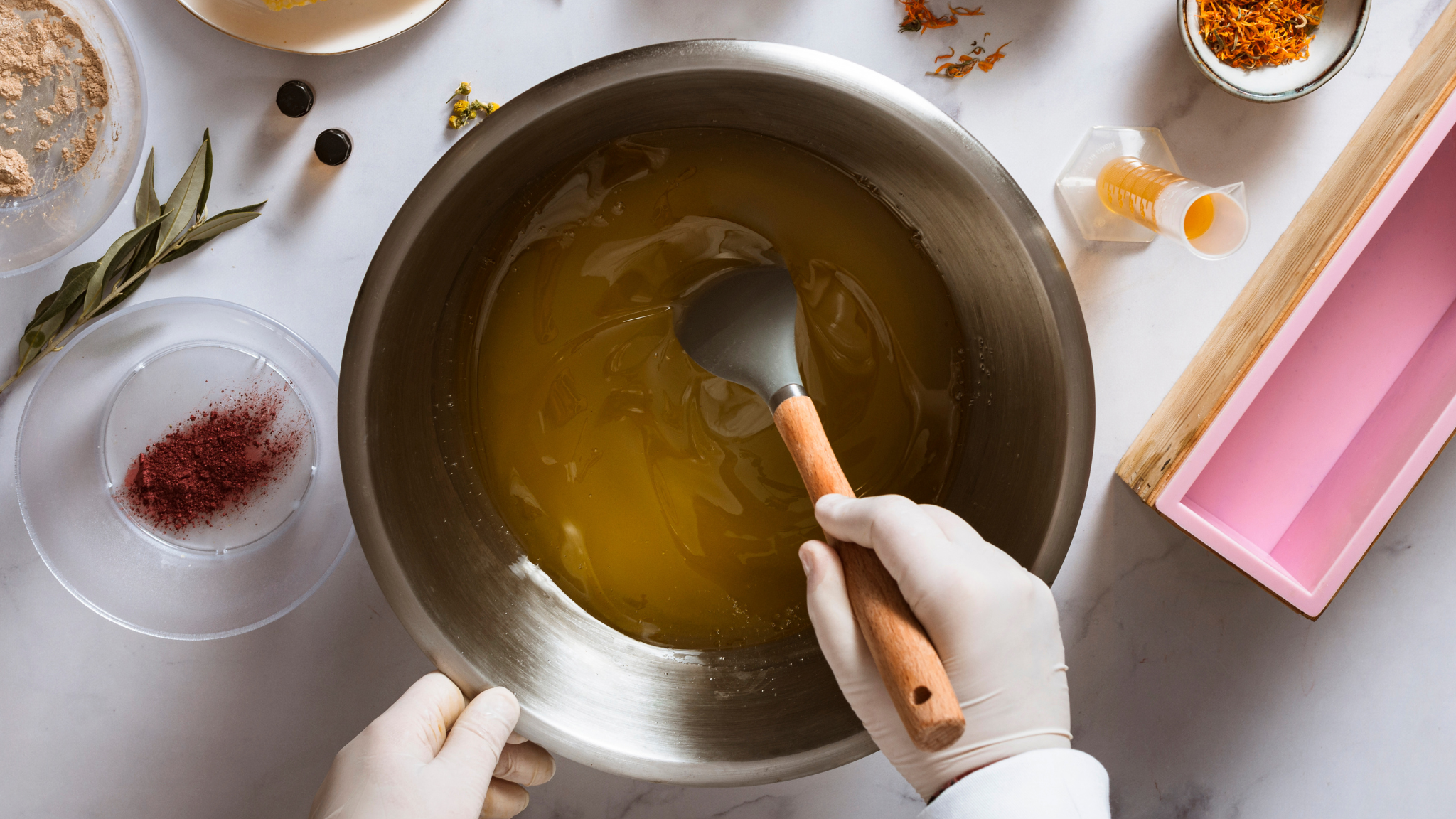
Mandatory Safety Warning
Handling sodium hydroxide (lye/NaOH) requires mandatory safety equipment: splash-proof protective goggles and nitrile/latex gloves. Work in a well-ventilated area and keep lye strictly out of reach of children and pets.
How to make a 100% Coconut oil soap: A beginner’s guide
Coconut oil is one of my favorite oils to use after olive oil in handmade soap making. It produces a rich lather, makes firm bars and cleans the skin perfectly. But did you know that you can make soap using coconut oil as your only vegetable oil?
A 100% coconut oil soap is a recipe that is particularly interesting for beginners who want to understand the basics of soap formulation. Especially because it produces a highly cleansing bar that requires some modifications based on the type of soap you want to make.
In this article, we will discover the properties of coconut oil in soap making, learn how to calculate the right amount of sodium hydroxide and follow a step-by-step method to help you make your own version of this soap.
What is a 100% coconut oil soap?
A 100% coconut oil soap is made with coconut oil as the only fat in the recipe. (It’s repetitive, but stay focused.) Unlike recipes that combine multiple fats like olive oil, shea butter, and castor oil. This formulation relies entirely on the properties of the coconut oil to predict the characteristics of the final finished bar.
Coconut oil is rich in lauric acid and myristic acid, two fatty acids that contribute to a firm bar and abundant lather. Here are some of the main characteristics of that type of soap:
Hard bars : Coconut oil produces relatively firm bars of soap.
Abundant lather : It creates a generous lather with large bubbles.
Strong cleansing power : It’s effective at removing oils and dirt.
Quick unmolding : The bars can often be removed from their molds sooner than some softer formulations.
However, there is one important drawback. Coconut oil soap can be too cleansing and drying for some people's skin. In order to make it comfortable and usable, we have to use the right amount of caustic soda. This means that we have to superfat it properly. This is why many soap makers use a higher superfat percentage when they make a soap with only coconut oil.
Ingredients needed to make Coconut oil soap
For this example, we will use a small batch of soap made with 400 g of coconut oil. You will need:
Coconut oil 400 g
Sodium hydroxide (NaOH) 58 g
Distilled water 136 g
Sodium hydroxide is the alkali used to turn oils into solid soap through a chemical reaction called saponification. It's very corrosive, so you need to wear protection when you manipulate this product.
Important : Always pour the sodium hydroxide into the water.
How to check if you have the right amount of sodium hydroxide?
This is one of the most important steps when formulating a soap recipe. Each oil has a different saponification value, which indicates how much alkali (NaOH) is required to react with a given quantity of oil. Coconut oil has a relatively high NaOH saponification value compared with many other common soap-making oils.
For illustration, we can use an approximate NaOH SAP value of 0.183 g of NaOH per gram of coconut oil. The exact value can vary with the oil.
You can calculate it this way:
NaOH required at 0% superfat = oil weight × NaOH SAP value
For 400 g of coconut oil, you would do:
400 × 0.183 = 73.2 g of NaOH
This is the approximate amount required for 0% superfat using the assumed SAP value.
Adjusting the recipe for superfat
Superfat means that the formulation includes a calculated excess of oil relative to the amount of NaOH required for complete saponification. This can help make a 100% coconut oil soap less harsh.
For a coconut oil soap, we normally do 20 to 30% superfat. However, I personally find that above 25% the soap feels really oily. So, we will use 20% superfat.
The method is:
NaOH (at 20% superfat) = NaOH (at 0% superfat) × (1 − superfat)
Therefore:
73.2 g of NaOH × (1 − 0.20) = 58.56 g of NaOH
Our 20% superfat formula is then:
Why Use a 20% Superfat?
Many traditional soap recipes use a superfat of around 5 to 10%. However, 100% coconut oil soap is a special case. Because coconut oil is rich in lauric and myristic acids, the resulting soap can have strong cleansing properties. So using a superfat of approximately 20% to 30% is required to make this soap comfortable.
A higher superfat may make the finished soap feel less stripping, but it does not guarantee that the soap will suit every skin type. It is also important to understand that superfat is a formulation parameter, not a precise measurement of the free oil remaining in the finished bar.
Making the soap
Once your formula has been checked, you can begin making the soap.
Step 1: Prepare your workspace
Work in a well-ventilated area, away from children, pets, food, and distractions.
Gather your equipment:
A digital scale with suitable precision
Stainless steel containers
A gas mask
A silicone spatula
A stick blender
A soap mold
A thermometer
Chemical-resistant gloves and splash goggles
Wear appropriate protective clothing and ensure that your workspace is ready before handling sodium hydroxide. Never use aluminum containers.
Step 2: Weigh the ingredients
Weigh each ingredient separately using a digital scale. Accuracy is essential in soap making, especially when measuring sodium hydroxide.
Step 3: Prepare the lye solution
Slowly add the sodium hydroxide to the water while stirring gently. Always add sodium hydroxide to water, never water to sodium hydroxide. The mixture heats up rapidly and releases fumes during dissolution. Avoid breathing these fumes and keep your face away from the container.
Step 4: Melt the coconut oil
Coconut oil is solid at typical room temperatures, so it needs to be melted before mixing.
Step 5: Combine the oil and lye solution
Slowly pour the prepared lye solution into the melted coconut oil. Using an immersion blender, mix until the preparation reaches the "light trace" stage. "Trace" refers to the point at which the soap batter thickens slightly and leaves a fleeting mark visible on its surface.
Step 6: Pour the soap into the mold
Pour the soap batter into your prepared mold.
Step 7: Unmold and cut the soap
Check the soap after approximately 24 hours. If the soap is firm enough, remove it from the mold and cut it into bars. If it is still soft, give it more time.
Step 8: Allow the soap to cure
Place the bars on a rack with space between them to allow air circulation. A curing period of approximately 4 to 6 weeks is a common starting point for cold-process soap. During this time, water evaporates and the bars generally become harder.
Is 100% Coconut Oil Soap Suitable for Everyone?
Not necessarily. Although coconut oil soap can produce a beautiful lather and a hard bar, its high cleansing power can be unsuitable for people with dry or sensitive skin. A higher superfat can improve the feel of the soap, but each person has their own sensitivities.
Common Mistakes to Avoid
Here are some mistakes to watch for when making your first coconut oil soap. Using too much sodium hydroxide. An incorrect lye calculation can result in a dangerous soap.
Using too little water without adjusting the process. A concentrated lye solution can cause the batter to thicken rapidly and make the recipe harder to handle.
Working without protective equipment. Sodium hydroxide can cause serious chemical burns. Gloves, splash goggles, protective clothing, and effective ventilation are essential.
Unmolding the soap too early. Even if the outside appears firm, the soap may still be too soft to cut cleanly.
Assuming that a long cure fixes every problem. Curing helps harden soap, but it does not correct an excessive amount of sodium hydroxide.
Put theory into practice with zero risk of error
Download our comprehensive kit with automated lye calculator and complete oil guide to safely formulate your own signature soaps.
Discussion & Comments (0)
Leave a comment